
Red Light Therapy System Buying Guide
What to Know Before Buying a Red Light Therapy System
Red light therapy systems use specific red, near-infrared, and in some cases additional light wavelengths to support wellness, recovery routines, skin-focused use, and whole-body light exposure in home, spa, studio, and professional environments. Choosing the right system depends on coverage area, wavelength configuration, device style, session length, placement needs, controls, portability, and whether the system will be used for targeted, facial, full-body, home, or commercial use.
Some buyers need a compact mask for facial routines. Others need a strapped wearable device for targeted joint positioning, a flexible pad or panel for body-contact use, a freestanding panel for larger treatment areas, or a full-body bed-style system for professional or advanced home environments.
SanaVi’s red light therapy lineup can generally be understood in five practical groups:
Facial and skincare-focused wearable systems: Lumara VISO Red Light Therapy Mask.
Targeted wearable joint systems: Kineon MOVE+.
Flexible body-contact systems: Lumara Red Light Therapy Pad and Lumara Illuminate V2 Flexible Panel.
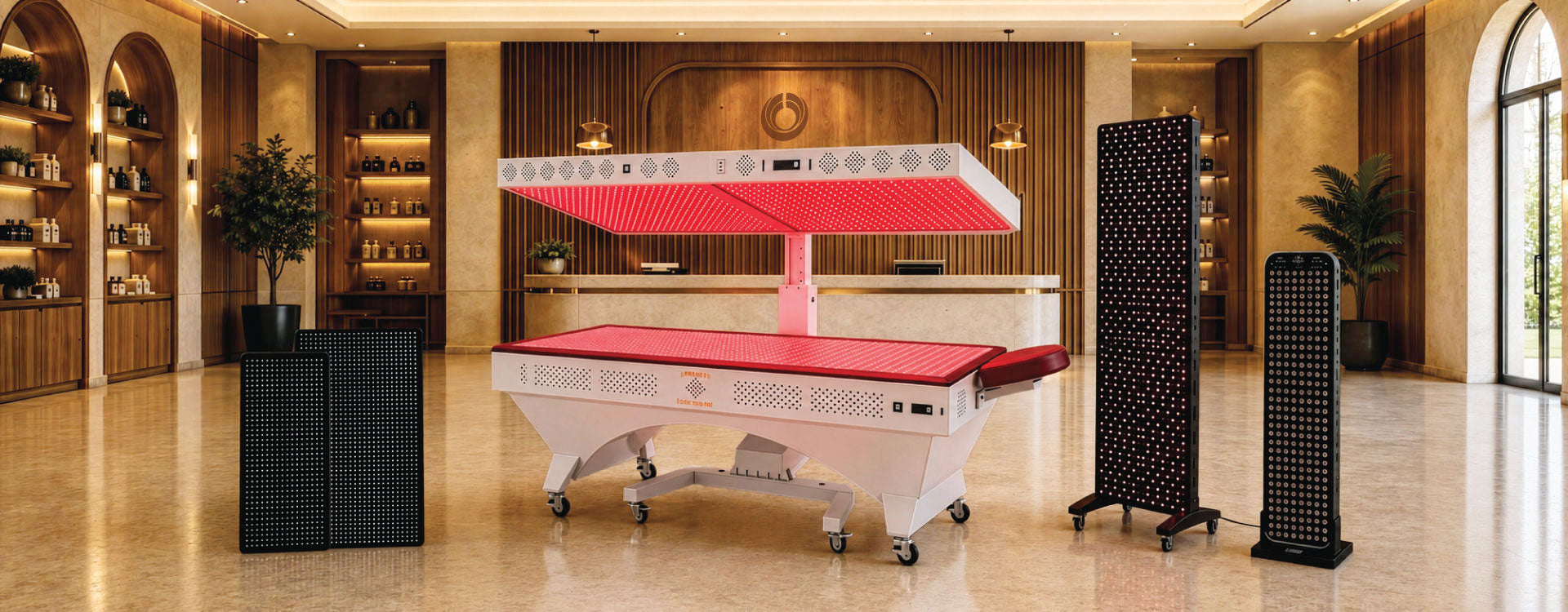
Freestanding larger-coverage panels: Renew Red Light Large Panel and Renew Red Light Max Panel.
Full-body professional and advanced home systems: Prestige Pro Modular 9-Wavelength Red Light Therapy Bed.
Commercially designed red light therapy systems may also be appropriate for home use when the buyer has the space, budget, placement plan, and long-term use expectations to support a larger system.


Core Buying Considerations
1. Device Type and Coverage Area
Device type is one of the most important buying considerations because red light therapy systems can be designed for very different use patterns.
The Lumara VISO Red Light Therapy Mask is a face-focused wearable system with a flexible facial mask design, 470 micro-LEDs, a 10 in × 7 in oval shape, and direct-contact use across the face. It is best suited for customers who want a dedicated facial red light therapy device rather than a panel, pad, or full-body system.
The Kineon MOVE+ is a targeted wearable system built around three modular LED + laser treatment units, an adjustable strap system, a rechargeable control module, and a travel case. It is designed for direct skin-contact placement across joint areas such as the knee, shoulder, back, neck, elbow, wrist, and ankle.
The Lumara Red Light Therapy Pad is a flexible body-contact system available in Small 11 in × 11 in, Long 12 in × 30 in, and Large 20 in × 30 in sizes. This gives buyers a choice between more targeted coverage and larger body-area coverage depending on the treatment area.
The Lumara Illuminate V2 Flexible Panel is a flexible 18.25 in × 11.25 in red light therapy panel designed for short, efficient sessions across the face or body. It is more compact than a freestanding panel but broader than a facial-only device.
The Renew Red Light Large Panel and Renew Red Light Max Panel are freestanding vertical systems for larger coverage. The Large Panel measures 43 in high × 10.2 in wide × 2.4 in deep, while the Max Panel measures 75 in high × 24 in wide × 2.7 in deep.
The Prestige Pro Modular 9-Wavelength Red Light Therapy Bed is a full-body modular system with upper and lower panels that may be used together or separately. Its full modular system dimensions are approximately 75.7 in long × 35.4 in wide × 50.2 in high.
2. Home Use, Professional Use, and Advanced Home Use
Red light therapy systems should not be divided too simply into “home only” and “commercial only” categories.
The Lumara VISO Mask, Lumara Pad, Lumara Illuminate V2, and Kineon MOVE+ are the easiest systems to integrate into home routines because they are compact, portable, wearable, or flexible. These products can also be appropriate in professional environments where targeted, facial, or body-contact use is needed.
The Renew Red Light Large Panel and Renew Red Light Max Panel are stronger bridge systems. They provide larger coverage than smaller wearables or pads while still operating without permanent installation. These panels can fit home wellness rooms, home gyms, offices, treatment rooms, wellness studios, and recovery-focused spaces when room layout and positioning are considered.
The Prestige Pro Modular 9-Wavelength Red Light Therapy Bed is designed as a professional red light therapy / photobiomodulation system for clinics, recovery centers, wellness facilities, professional treatment rooms, and advanced home wellness programs. It may also be appropriate for home buyers who have the dedicated space, budget, and placement needs for a full-body red light therapy bed-style system.
For SanaVi customers, the right choice depends less on whether a system is labeled “home” or “professional” and more on how it will actually be placed, used, controlled, and supported over time.
3. Wavelengths and Light Type
Wavelength configuration affects the type of light delivered by each system and is one of the most important specifications to keep product-specific.
The Lumara VISO Mask uses a 660 nm red light wavelength.
The Lumara Illuminate V2 Flexible Panel also uses a 660 nm red light wavelength and is designed around concentrated red light delivery in short sessions.
The Lumara Red Light Therapy Pad uses three wavelengths: 635 nm red light, 830 nm near-infrared, and 940 nm near-infrared. Its 3-in-1 LED design places all three wavelengths at each LED location.
The Kineon MOVE+ combines 660 nm deep red LEDs with 808 nm near-infrared Class 1 laser diodes. This makes it different from standard LED-only red light therapy products and places it in a targeted wearable LED + laser category.
The Renew Red Light Large Panel uses six red and near-infrared wavelengths: 610 nm, 630 nm, 660 nm, 810 nm, 830 nm, and 850 nm.
The Renew Red Light Max Panel uses seven wavelengths: 450 nm blue light, 610 nm, 630 nm, 660 nm, 810 nm, 830 nm, and 850 nm.
The Prestige Pro Modular 9-Wavelength Red Light Therapy Bed uses nine wavelengths: 480 nm blue light, 590 / 599 nm yellow light, 630 nm, 660 nm, and 670 nm red light, plus 810 nm, 830 nm, 850 nm, and 1060 nm near-infrared light.
Buyers should compare wavelengths carefully because “red light therapy system” can describe anything from a single-wavelength facial mask to a multi-wavelength full-body professional system.
4. Flexible, Wearable, Panel, or Bed Configuration
The physical configuration of the system affects comfort, setup, positioning, and the type of routine it supports.
Wearable systems like the Lumara VISO Mask and Kineon MOVE+ are designed for direct-contact placement. The VISO Mask uses an adjustable head strap for facial positioning, while the Kineon MOVE+ uses an adjustable strap system to secure modular treatment units around targeted joint areas.
Flexible systems like the Lumara Pad and Lumara Illuminate V2 can be positioned on or near the body without requiring a permanent installation. The pad is designed to conform with the body, while the Illuminate V2 uses a flexible panel form that can be used across the face or body.
Freestanding systems like the Renew Large Panel and Renew Max Panel offer larger coverage in a vertical panel format. These are better suited for users who want broader exposure without holding or wearing the device during a session.
The Prestige Pro Modular Bed is a full-body system with upper and lower panels, one-person capacity, and full-body upper and lower light exposure. It is more substantial than a panel or pad and requires more deliberate placement planning.
5. Session Time, Positioning, and Ease of Use
Session time and positioning can strongly affect whether a system fits into a customer’s routine.
The Lumara VISO Mask is typically used for 5–20 minutes per session and is designed for seated or lying-down facial use.
The Lumara Illuminate V2 is designed for approximately 5-minute sessions per treatment area, making it one of the shorter-session products in this lineup.
The Lumara Red Light Therapy Pad is designed for approximately 20–30 minute sessions per treatment area and may be selected by pad size depending on whether the buyer needs smaller targeted coverage or extended body-area coverage.
The Kineon MOVE+ is designed for 5–15 minute sessions, with a recommended frequency of 1–2 sessions per day and a maximum of twice daily.
The Renew Red Light Large Panel and Renew Red Light Max Panel list recommended treatment times of 10–20 minutes per session, 3–5 times per week.
The Prestige Pro Modular 9-Wavelength Bed includes a 1–30 minute session timer and more advanced control over modes, brightness, and pulse/frequency settings.
For home buyers, ease of use may mean quick setup, simple positioning, and repeatable routines. For professional settings, session control, user turnover, room layout, and consistent positioning may matter more.
6. Controls, Power, and Portability
Controls and power requirements vary widely across this product vertical.
The Lumara VISO Mask uses a wall power adapter with standard U.S. outlet compatibility and a handheld controller with timer and session controls.
The Lumara Illuminate V2 and Lumara Red Light Therapy Pad both operate on 120–240V power. The Illuminate V2 includes a 12 ft power cord, strap, arch handle, protective goggles, carrying case, and user manual. The pad uses a flexible, body-conforming design and standard household power.
The Kineon MOVE+ is rechargeable and portable, with a lithium-ion battery system, magnetic charging dock, USB charging cable, integrated control module with digital display, single-button activation, automated session timing, and up to approximately 24 ten-minute sessions per full charge.
The Renew Large Panel operates on AC 100–240V and includes touch key controls with integrated voice control functionality. The Renew Max Panel also operates on AC 100–240V and includes touchscreen controls with remote controller functionality.
The Prestige Pro Modular Bed includes touchscreen interface controls, 2.4G remote control, Bluetooth app compatibility, brightness control from 1–100% per wavelength, independent 1–10,000 Hz pulse/frequency control per wavelength, and multiple preset modes.
For buyers, simpler controls may be better for personal routines, while larger panels and professional systems may require more advanced control options for repeatable use, session management, and multi-user environments.
7. Warranty, Support, and Long-Term Fit
Warranty, support, and long-term fit matter because red light therapy systems can range from compact personal devices to substantial full-body systems.
Lumara panel and pad devices are backed by a 3-year manufacturer warranty, while Lumara masks are backed by a 2-year manufacturer warranty. The Lumara product pages also reference a 30-day money-back guarantee.
The Renew Large Panel and Renew Max Panel each list a 3-year manufacturer warranty covering defects in materials and workmanship from the original purchase date, with separate 6-month warranty coverage if a replacement unit is issued.
The Prestige Pro Modular 9-Wavelength Bed should be considered a more involved ownership decision because of its larger footprint, modular two-panel configuration, controls, app compatibility, and professional/full-body use environment.
For smaller systems, long-term fit may depend on whether the device is easy to use consistently. For larger systems, buyers should also consider placement, room access, user workflow, power access, service expectations, and whether the system fits a home, studio, clinic, or professional wellness environment.
Common Questions Before Choosing a Red Light Therapy System
Which red light therapy system is best for home use?
The best red light therapy system for home use depends on the desired treatment area, available space, setup preference, and routine. A mask may be best for facial use, a pad or flexible panel may fit targeted body routines, and a freestanding panel may work well in a home gym or wellness room. Larger commercial-style systems may also fit home use when space and placement are planned carefully.
What is the difference between a red light therapy mask, pad, panel, and bed?
A red light therapy mask is designed for facial use, while a pad or flexible panel is designed for more adaptable body-contact positioning. A freestanding panel provides larger vertical coverage without needing to be worn, and a red light therapy bed-style system is designed for full-body exposure in a more structured home or professional setting.
Do I need red light, near-infrared light, blue light, or multiple wavelengths?
The right wavelength configuration depends on the device type and intended use. Some products use a single red wavelength, while others combine red, near-infrared, blue, yellow, or additional wavelengths. Buyers should compare the exact wavelength list for each product rather than assuming all red light therapy systems use the same light configuration.
Are professional red light therapy systems only for commercial use?
No. Professional and commercial red light therapy systems may also be appropriate for home buyers who have the space, budget, and placement needs to support a larger system. Full-size panels and bed-style systems are often designed for professional environments, but they can also fit advanced home wellness spaces when room planning is handled properly.
How important is coverage area when choosing a red light therapy system?
Coverage area is one of the most important buying factors. A facial mask, joint wearable, small pad, flexible panel, vertical panel, and full-body bed all support different routines. Buyers should choose based on where the light needs to be applied, how much of the body they want to cover, and how easily they can position the system during repeated use.
What specifications matter most when comparing red light therapy systems?
The most important specifications include device type, wavelength configuration, LED or LED + laser design, coverage area, session time, controls, power source, portability, warranty, and placement requirements. Larger systems should also be compared by dimensions, weight, power, room fit, and whether the system is intended for home, professional, or advanced home use.
Why buy a red light therapy system through SanaVi Health Systems?
SanaVi Health Systems helps customers compare red light therapy systems by device type, coverage area, wavelength configuration, use environment, and long-term fit. We focus on clear product education, manufacturer-backed equipment, responsible wellness language, and practical buying guidance so customers can choose a system that fits their home or professional environment with confidence.
Ready to Compare Red Light Therapy Systems?
Choosing a red light therapy system starts with understanding how the device will actually be used. SanaVi helps customers compare masks, targeted wearable devices, flexible pads, panels, and full-body systems with a clear focus on coverage, placement, wavelengths, controls, and long-term fit for home or professional spaces.
STAY INFORMED
Wellness Knowledge, Delivered
Receive thoughtful wellness education,
practical buying guidance, and occasional SanaVi updates.