Skip to content

Review Your Cart

Your cart is empty

Whole Body Vibration Therapy System Buying Guide

What to Know Before Buying a Whole Body Vibration Therapy System
Whole body vibration therapy systems use controlled vibration platforms to support movement, training, recovery routines, and wellness-focused use in home, studio, and professional environments. Choosing the right Power Plate system depends on platform size, column or columnless design, frequency range, controls, user capacity, delivery needs, and whether the system will be used in a compact home setting, advanced residential space, professional studio, or commercial environment.

Some buyers need a compact, portable platform for personal routines. Others need a freestanding system with handles, a larger training surface, touchscreen controls, or integrated resistance features. Professional and commercial environments may need a heavier-duty platform designed for frequent use, multiple users, and a more structured training setting.

Power Plate systems can generally be understood in three practical groups: Compact and residential-friendly systems include Power Plate MOVE and Personal Power Plate. Home, studio, and advanced residential systems include Power Plate my5 and Power Plate my8. Professional and commercial-grade systems include Power Plate pro5, Power Plate pro5HP, Power Plate pro8, and Power Plate pro7HC.

Professional systems can also be appropriate for home use when the buyer has the space, budget, and desire for a larger or more advanced platform.

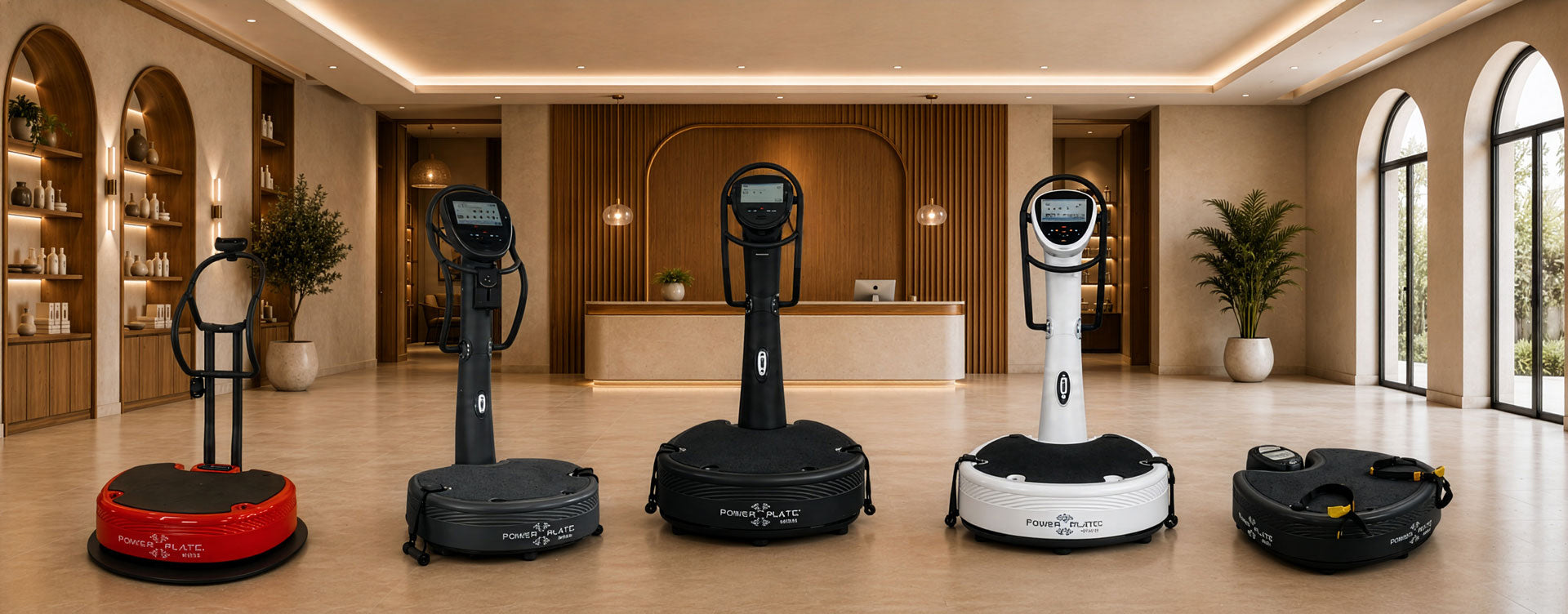
Whole body vibration therapy systems displayed in the SanaVi Health Systems showroom, featuring Power Plate vibration platforms arranged for comparison.
Power Plate Large Support Cushion vibration training accessory supporting lower body during exercise with Power Plate platform in home gym
Personal Power Plate vibration trainer positioned on the Personal Power Shield platform demonstrating how the vibration reduction base sits beneath the machine to help limit vibration transfer in home workout environments.
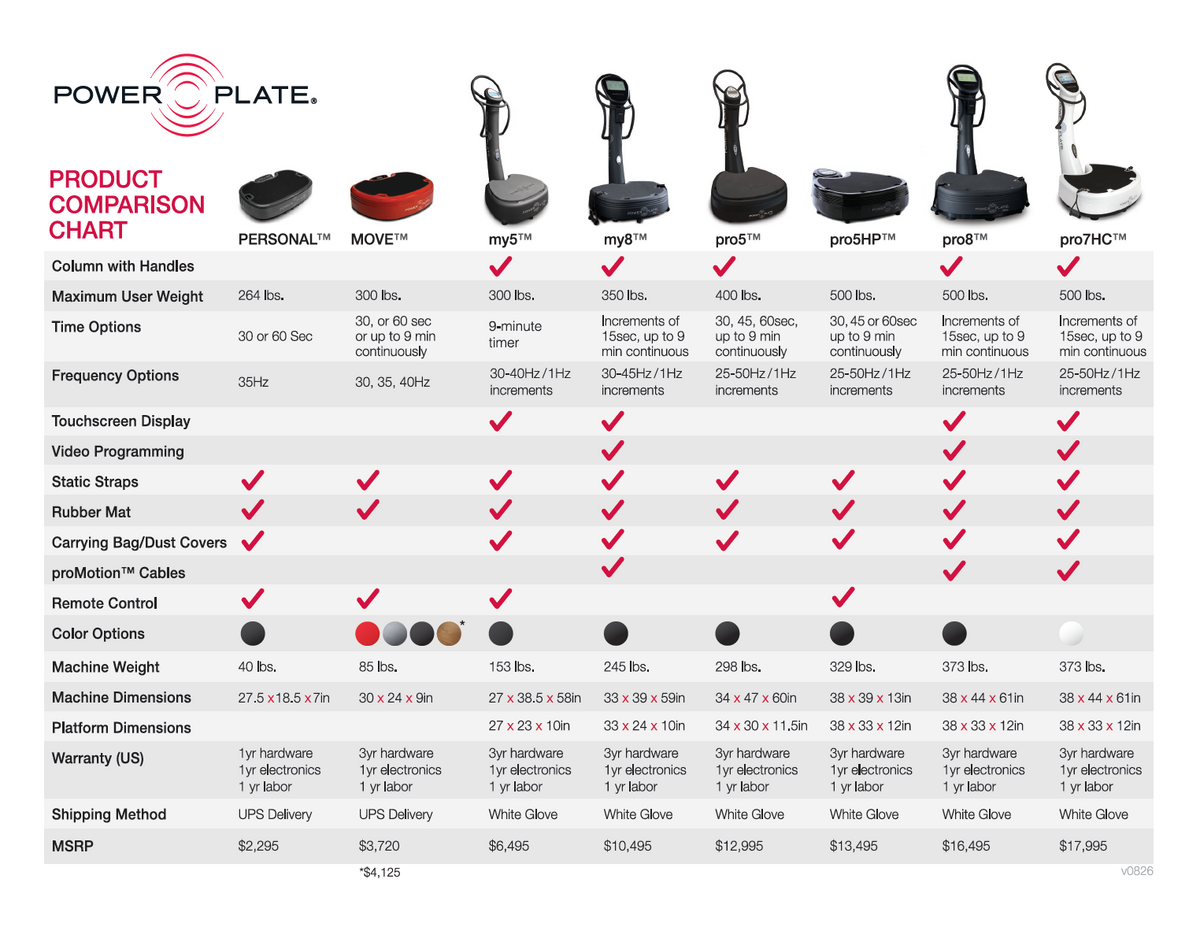
Power Plate whole body vibration product comparison chart showing my5, my8, pro5, pro5HP, pro8, pro7HC, MOVE, and Personal models with frequency, dimensions, weight, controls, warranty, and feature comparisons.

Core Buying Considerations

1. Platform Size and Placement

Platform size affects how the system fits into a room and how much movement space is available during use.

The Personal Power Plate is the smallest system in this lineup, with a compact platform-style design measuring 27.5 in wide x 18.7 in deep x 6.2 in high. It is best suited for buyers who want a smaller, easier-to-place whole body vibration trainer for home use.

The Power Plate MOVE is also a compact columnless platform, but it provides a larger surface and stronger configuration than the Personal Power Plate. MOVE measures 30.3 in wide x 24 in deep x 9 in high, with a 30.3 in x 22.7 in surface platform.

The my5 and my8 move into larger freestanding system territory. The my5 includes a column-style design with machine dimensions of 27 in wide x 38.5 in deep x 58 in high and a platform size of 27 in wide x 23 in deep x 10 in high. The my8 is slightly larger, with machine dimensions of 33 in wide x 39 in deep x 59 in high, platform dimensions of 33 in wide x 24 in deep x 10 in high, and a system weight of 245 lb.

The pro systems are larger, heavier, and more professionally oriented. The pro5 measures 38 in wide x 45 in deep x 60 in high. The pro5HP is a columnless high-performance platform measuring 38 in wide x 39 in deep x 13 in high. The pro8 measures 38 in wide x 44 in deep x 61 in high. The pro7HC measures 38 in wide x 46 in deep x 60 in high.

For home buyers, placement should be considered carefully. A compact platform may work well in a bedroom, home gym, or wellness room. A professional system may require a dedicated training area, stronger delivery planning, and more permanent placement.

2. Home Use, Professional Use, and Advanced Home Use

Not every system falls neatly into a “home only” or “commercial only” category.

The Personal Power Plate and MOVE are the most residential-friendly systems because they are compact, easier to position, and less demanding from a space-planning standpoint. MOVE is also suitable for light professional environments, personal training studios, and recovery-focused spaces.

The my5 and my8 are stronger bridge systems between compact residential platforms and larger professional equipment. The my5 is designed for home use and light commercial environments, including home gyms, personal wellness rooms, training studios, and wellness-focused spaces. The my8 provides another step up in features and training capability.

The pro5, pro5HP, pro8, and pro7HC are professional/commercial-grade Power Plate systems. These models are designed for more demanding environments such as wellness studios, fitness facilities, performance centers, rehabilitation clinics, and commercial wellness settings.

However, they can also be appropriate for home buyers who want a more substantial system and have the space, budget, and placement plan to support it.

For SanaVi customers, this distinction matters because the right system should match the buyer’s actual use environment — not just the category label.

3. Frequency Range and Vibration Settings

Frequency range affects how much adjustability the platform provides during vibration training.

The Personal Power Plate uses a consistent 35 Hz frequency with selectable low or high vibration energy output.

Power Plate MOVE provides six frequency and amplitude levels: 30 Hz low, 35 Hz low, 40 Hz low, 30 Hz high, 35 Hz high, and 40 Hz high. Its frequency range is 30–40 Hz.

Power Plate my5 provides an adjustable 30–40 Hz frequency range in 1 Hz increments, with preset frequencies of 30, 35, and 40 Hz and selectable Low or High amplitude settings.

Power Plate my8 provides a 30–45 Hz frequency range in 1 Hz increments and includes high or low vibration energy output.

The pro5, pro5HP, and pro8 each provide a 25–50 Hz frequency range in 1 Hz increments with low/high vibration energy output. The pro7HC also provides a 25–50 Hz frequency range, low/high amplitude, and 0–8 vibration settings with 27 sublevels of adjustable intensity.

For buyers, the key question is how much adjustability they need. Simpler systems may be better for straightforward home use. Wider frequency ranges and more control options may be preferred in professional, advanced training, or multi-user environments.

4. Platform Style and Training Support

Whole body vibration platforms vary significantly in how users interact with them.

Columnless platforms, such as the Personal Power Plate, MOVE, and pro5HP, provide an open training surface without a fixed upright column. This can be helpful when buyers want more freedom around the platform, easier storage, or the ability to integrate the platform with bodyweight exercises, floor-based positions, or other training equipment.

Column-style systems, such as my5, my8, pro5, pro8, and pro7HC, provide a more structured platform environment. These systems can offer handles, integrated controls, larger displays, or additional support during standing and guided movement routines.

The my8, pro8, and pro7HC add proMOTION-style resistance capability. This allows users to incorporate resistance-based upper-body movements while standing on the vibration platform.

That feature may be especially important for buyers who want a more complete training environment from one system.

5. Controls, Programs, and User Experience

Controls can make a major difference in how approachable the system feels.

The Personal Power Plate is simple and focused and includes remote control operation, with 30- or 60-second time selections and low/high vibration energy output.

MOVE includes remote control operation, six levels, multiple time settings, and 30- and 60-second presets available through the remote.

my5 includes a 5-inch LCD touchscreen display, an up-to-9-minute countdown timer, four preset exercise programs — Flexibility, Core, Strength, and Massage — a secondary lower control console with repeat button, and an included remote control. Its 30–40 Hz frequency range can also be adjusted in 1 Hz increments for more precise control.

my8 adds a 10.1 in touchscreen interface, Android operating system, proprietary Power Plate my8 software, electronic proMOTION resistance control, and time selections from 0–9 minutes in 15-second increments and a secondary floor-level control panel.

pro5 uses a user-friendly interactive display with timer selections of 30, 45, or 60 seconds, with sessions up to 9 minutes and a secondary floor-level control panel.

pro5HP uses a user-friendly display and remote control.

pro8 includes a 10.1 in touchscreen computer, Android operating system, proprietary pro8 software, electronic proMOTION resistance control, and password-enabled usage control, along with a secondary floor-level control panel.

pro7HC includes a 10.1 in capacitive touchscreen LCD display and secondary floor-level control panel, Android operating system, integrated ANT+ wireless heart rate monitoring, proMOTION dynamic resistance, and adjustable vibration levels.

For home use, simple controls may be preferable. For professional use, guided interfaces, touchscreen controls, resistance adjustments, and multi-user control features may be more important.

6. Weight Capacity and System Weight

Weight capacity is one of the easiest specifications to compare, but it should not be the only buying factor.

The Personal Power Plate supports up to 264 lb and weighs 40.4 lb.

Power Plate MOVE supports up to 300 lb and weighs 87 lb without packaging.

Power Plate my5 supports up to 300 lb and weighs approximately 153 lb.

Power Plate my8 supports up to 350 lb and weighs 245 lb.

Power Plate pro5 supports up to 400 lb and weighs 407 lb.

Power Plate pro5HP supports up to 500 lb and weighs 351 lb without case.

Power Plate pro8 supports up to 500 lb and weighs 373 lb.

Power Plate pro7HC supports up to 500 lb and weighs 430 lb.

For individual home use, compact weight and easier placement may matter more. For clinics, studios, and higher-use environments, heavier professional systems may provide the stability and capacity expected in a commercial setting.

7. Delivery, Installation, and Support

Delivery and setup expectations vary across the lineup.

Compact platforms are easier to place than large professional systems, but buyers should still consider system weight, room access, electrical access, and how the platform will be used.

All of the larger Power Plate systems, including the my and pro series, include White Glove Delivery and Installation. This is especially important for professional and commercial-grade systems where system weight, placement, and setup coordination matter more.

SanaVi Health Systems helps customers think through system fit, room planning, intended use, delivery expectations, and manufacturer-backed support before purchase. That support matters because a whole body vibration system is not just a device on a product page — it is a physical system that needs to fit the buyer’s space, training style, and long-term use expectations.

Common Questions Before Choosing a Whole Body Vibration System

Ready to Compare Whole Body Vibration Therapy Systems?

Explore SanaVi’s Power Plate whole body vibration lineup, continue learning through our vibration therapy articles, or talk with a SanaVi specialist for help choosing the right system for your home or professional space.